What Is PMI? Cost, Who Pays, and How to Remove It
PMI gets talked about like a penalty for not having 20% down. It isn't. It's closer to a toll road: you pay a fee for a while, and in exchange you get there years sooner.
That doesn't mean you should ignore it. PMI is one of the most misunderstood line items on a mortgage, and the borrowers who understand it tend to pay less of it, for less time. Here's what it is, what it costs, and how to make it go away, including when the only way out is a refinance.
1. What PMI actually is
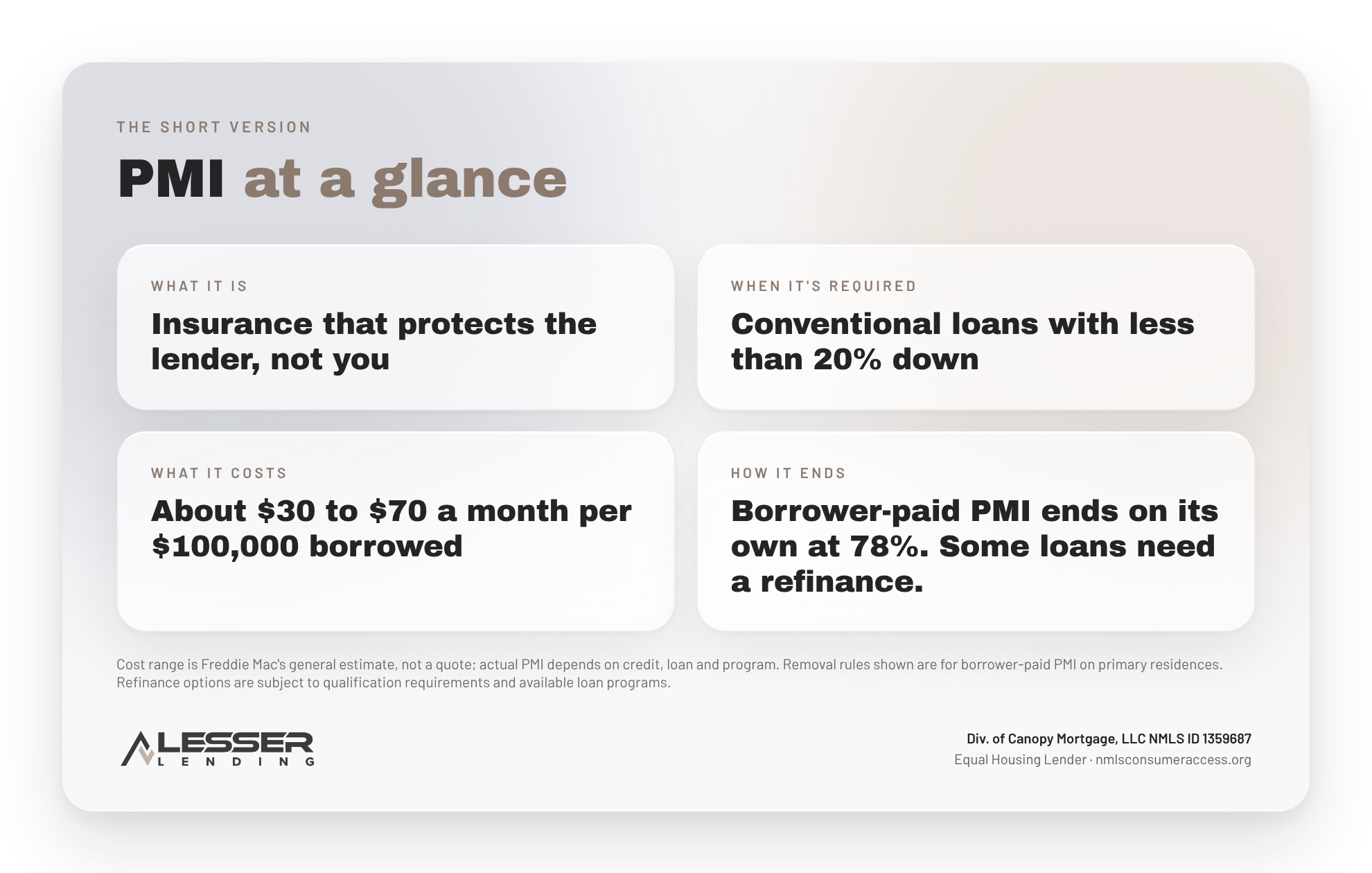
Private mortgage insurance (PMI) is insurance on a conventional loan when you put less than 20% down. You pay the premium, but it protects the lender, not you. If a loan goes into default and the home sells for less than what's owed, the mortgage insurance company covers part of the lender's loss.
That's the whole trade. The lender takes on more risk by lending more of the home's value, and PMI is what makes that risk acceptable. Without it, a lot of lenders simply wouldn't make low down payment conventional loans.
PMI is not homeowners insurance, and it's not mortgage protection insurance. It doesn't pay your mortgage if you lose your job. It doesn't fix your roof. It's there for the lender.
Do this instead: Stop thinking of PMI as wasted money and start thinking of it as a cost of access. The real question is whether that access is worth it for your situation, and for a lot of buyers it is.
2. Which loans charge mortgage insurance
"PMI" technically means conventional loans only. Other loan types have their own version, with different names and very different rules.
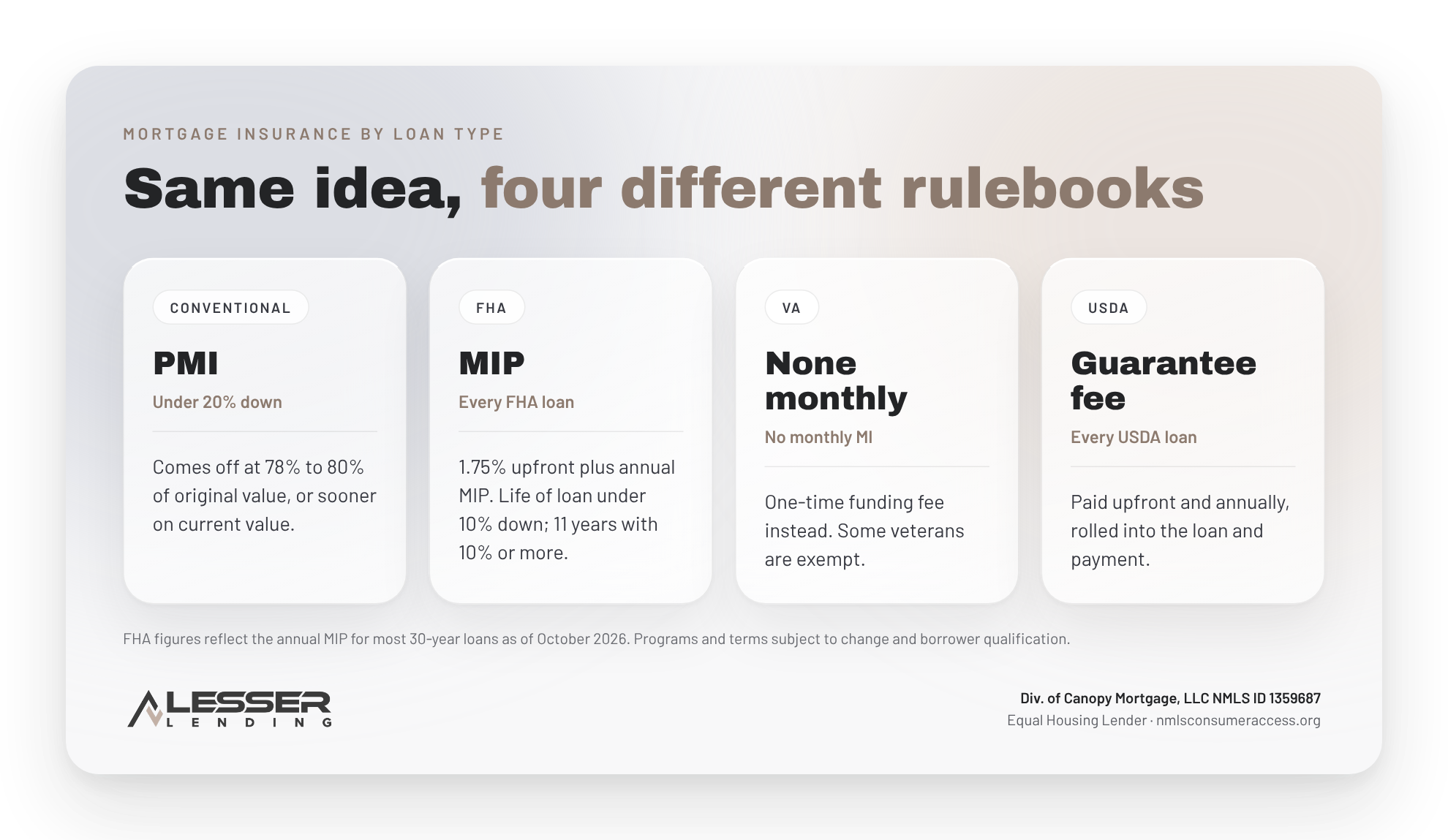
Conventional: PMI when you put less than 20% down. Borrower-paid PMI can come off later without refinancing.
FHA: Mortgage insurance premium (MIP), with an upfront premium and an annual premium. It plays by its own rules (more on that below).
VA: No monthly mortgage insurance at all. There's a one-time funding fee instead, and some veterans are exempt from it.
USDA: A guarantee fee, paid upfront and annually. The annual fee stays for the life of the loan.
That's the biggest difference between them. Borrower-paid PMI on a conventional loan is built to come off on its own. On most of the others, the way out is a refinance. Subject to qualification requirements and available loan programs.
Ask your lender this: "Which loan types am I eligible for, and how does the mortgage insurance compare on each one?" A good lender explains this clearly, because the cheapest-looking loan isn't always the cheapest over time.
3. What PMI costs, and what moves the price
According to Freddie Mac, PMI typically runs "approximately between $30 and $70 per month for every $100,000 borrowed." That's Freddie Mac's general estimate, not a quote, and your actual PMI depends on your credit, loan, and program. It's also a wide range, and where you land depends on a handful of things:
Credit score. This is usually the biggest lever. Higher scores get meaningfully cheaper PMI.
Down payment. 15% down prices better than 10%, and 10% prices better than 3%.
Debt-to-income ratio. Higher ratios can push the premium up.
Loan details. Loan amount, term, and the amount of coverage the loan requires all play a part.
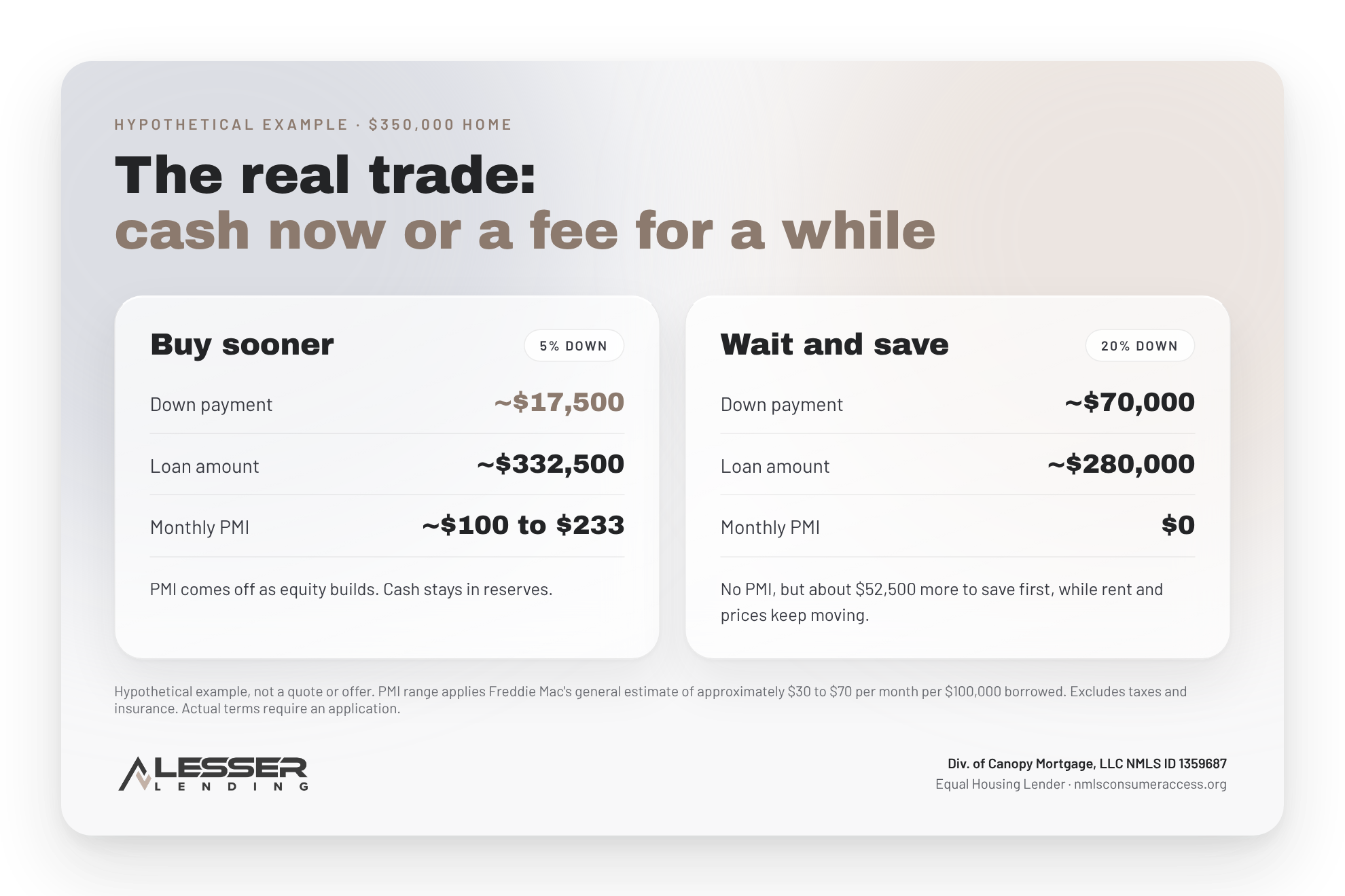
Here's a hypothetical example, not a quote. On a $350,000 home in eastern Washington with 5% down, the loan would be about $332,500. Applying Freddie Mac's general estimate, PMI could land somewhere around $100 to $233 a month. This is for illustration only and is not a quote or offer of credit. Actual PMI depends on your credit, the loan, and the program, and requires a completed application.
Do this instead: Don't guess at your PMI from a calculator and walk away discouraged. Run the payment on our Mortgage Calculator for a ballpark, then get your real number from an application.
Want your real number? Apply with us and we'll review available loan options based on your qualifications, including the mortgage insurance that comes with each.
4. Treating PMI as a penalty instead of a tool
This is where people screw this up. They decide PMI is bad, so they wait until they have 20% saved. On that same $350,000 home, that's the difference between bringing about $17,500 for the down payment and bringing about $70,000.
That gap is $52,500. For most people, that's years of saving. And while you save, you're still paying rent, and the price of the house you wanted isn't standing still.
Waiting for 20% has a cost too. It just doesn't show up as a line item, so nobody notices it.
None of this means 20% down is wrong. If you have it and it doesn't drain your reserves, putting it down can make a lot of sense. But 20% down is a choice, not a rule, and it should be weighed against what that cash could do for you elsewhere, like keeping a real emergency cushion after closing.
Ask your lender this: "If I put down less than 20%, what does my payment look like, and how long would PMI likely stay on?" Ask your lender to walk you through the tradeoff with your actual numbers, not a rule of thumb.
5. The different ways to pay for PMI
Most people assume PMI is always a monthly charge. It usually is, but it isn't the only option.
Borrower-paid monthly PMI
The most common setup. The premium is added to your monthly payment, and it comes off once you hit the removal rules below.
Single-premium PMI
You pay the whole premium once, at closing. No monthly PMI. In some cases, seller credits can potentially go toward a single premium, within program and transaction limits. The catch: if you sell or refinance early, you don't get that money back.
Lender-paid mortgage insurance
The lender pays the premium in exchange for a higher interest rate. Your payment can look cleaner, but that higher rate is baked in for the life of the loan. It doesn't come off at 78% the way borrower-paid PMI does. The only way out is to refinance. Subject to qualification requirements and available loan programs.
Do this instead: Treat how you pay PMI as part of your loan strategy, not a box that gets checked for you. The right answer depends on how long you expect to keep the loan.
Ask your lender this: "Would single-premium or lender-paid MI make sense for me, and why?" Ask your lender how they'd structure this, and why.
6. How PMI comes off, and when it takes a refinance
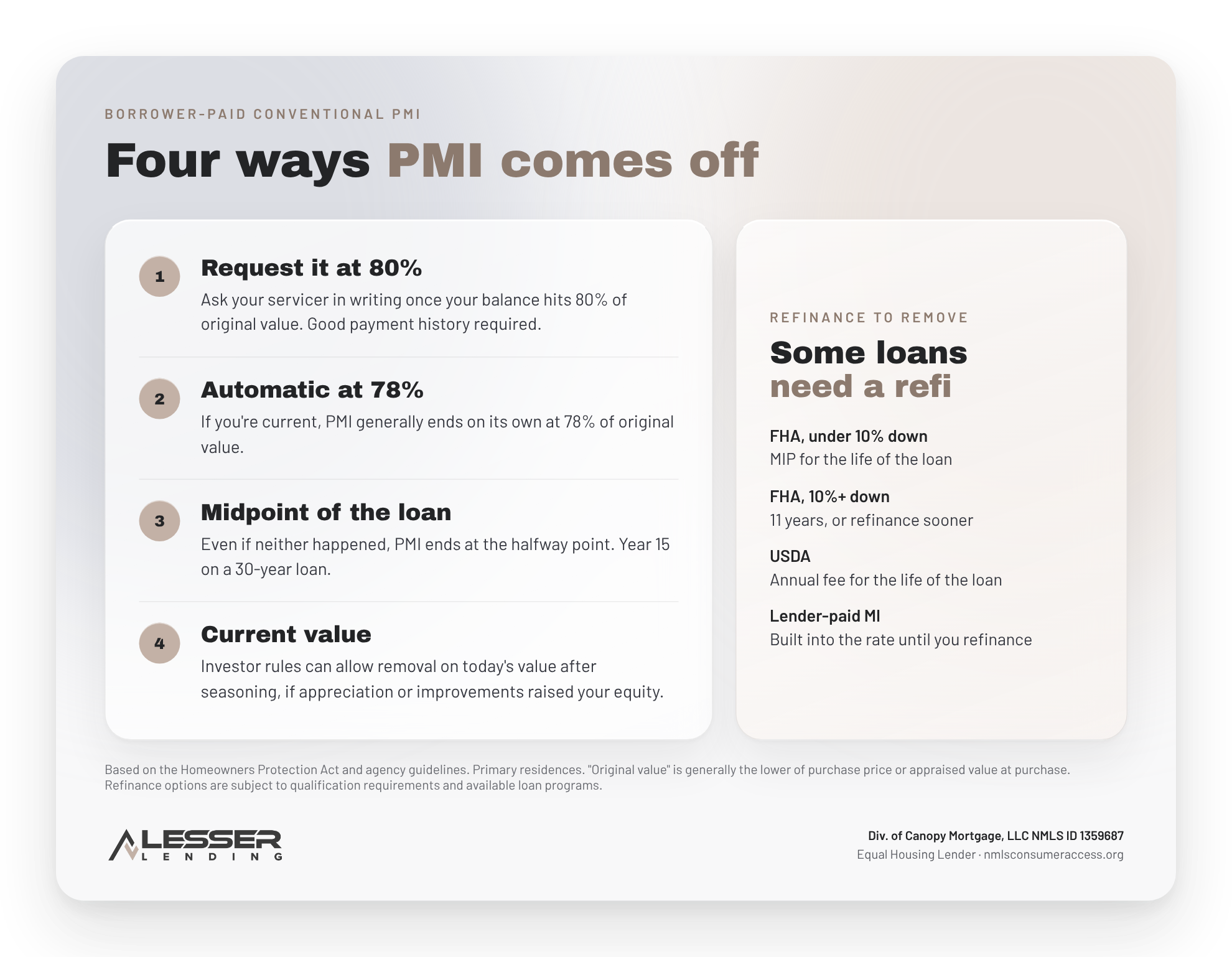
Borrower-paid PMI on a conventional loan is the one type of mortgage insurance built to come off without refinancing. There are four main exits.
Request it at 80%. Under the federal Homeowners Protection Act, you can ask your servicer in writing to cancel PMI once your balance reaches 80% of the home's original value. You'll generally need a good payment history, no second liens, and proof the home hasn't lost value, which can mean an appraisal.
Automatic at 78%. If you're current on payments, PMI generally ends on its own when your scheduled balance hits 78% of the original value.
Midpoint of the loan. If neither of those has happened, PMI has to end once you reach the halfway point of the loan's schedule, as long as you're current. On a 30-year loan, that's year 15.
Current value. Fannie Mae and Freddie Mac rules can let you remove PMI based on your home's current value, after a seasoning period, if appreciation or improvements have pushed your equity up. Extra principal payments can also get you to 80% sooner.
"Original value" usually means the lower of your purchase price or the appraisal when you bought. That's why the current-value route matters: if your home has gained value, you may not have to wait for the original schedule.
These rules are written for primary residences. Second homes and investment properties can follow different investor rules, so ask before you count on them.
When a refinance is the only way out
Not every loan lets you remove mortgage insurance. On these, the only way to get rid of it is to refinance into a different loan:
FHA with less than 10% down. Annual MIP stays for the life of the loan.
FHA with 10% or more down. MIP lasts 11 years. Refinancing is the only way off sooner.
USDA. The annual guarantee fee stays for the life of the loan.
Lender-paid mortgage insurance. The cost is built into your rate, so it stays until the loan is paid off or refinanced.
Here's the part nobody tells you: a refinance isn't automatic. It depends on your equity, your credit, your income, where rates are when you want out, and closing costs. That doesn't make these loans a bad choice. It means the exit needs a plan, not an assumption.
Ask your lender this: "Does mortgage insurance on this loan ever come off, or would I need to refinance? Roughly what would need to be true for that refinance to make sense?" A good lender explains this clearly before you close, not after.
Do this instead: PMI doesn't have to be forever. Plan the exit on day one. On borrower-paid conventional PMI, know your 80% and 78% dates. If your loan's exit is a refinance, know roughly how much equity you'd need and check our Refinance Check once you think you're there.
Not sure where you'd land? Start an application and we'll review available loan options based on your qualifications, including how long mortgage insurance would likely stay on.
7. FHA mortgage insurance follows different rules
FHA's mortgage insurance premium works differently from PMI, and that difference matters.
Upfront MIP: 1.75% of the loan amount, usually rolled into the loan.
Annual MIP: 0.55% of the loan per year for most 30-year FHA loans, split into your monthly payment.
How long it lasts: With less than 10% down, annual MIP stays for the life of the loan. With 10% or more down, it lasts 11 years.
FHA isn't a bad loan. It just has a different exit. For some buyers, especially with lower credit scores, FHA's mortgage insurance can actually cost less each month than conventional PMI would. The common exit is refinancing into a conventional loan once you've built enough equity and the numbers make sense. Subject to qualification requirements and available loan programs.
Ask your lender this: "Should I go FHA now and plan a refinance later, or start conventional?" A good lender explains this clearly, with the math for both paths.
8. PMI and your 2026 taxes
For years, mortgage insurance premiums weren't deductible. The One Big Beautiful Bill Act brought the deduction back starting with tax year 2026.
There are limits. You have to itemize, so if you take the standard deduction, it won't help you. The deduction also phases out at higher incomes, shrinking above $100,000 of modified adjusted gross income and disappearing at $109,000 for married couples filing jointly (half those amounts for married filing separately).
Do this instead: Don't count on the deduction when you're deciding what you can afford. Treat it as a possible bonus, not part of your budget. We're mortgage people, not tax advisors. Consult a tax advisor.
Frequently asked questions
Is PMI worth paying?
Often, yes. PMI lets you buy with far less cash, and borrower-paid PMI on a conventional loan can come off as you build equity. On FHA, USDA, and lender-paid MI, getting rid of it usually means refinancing. The better question is how much you'd pay and for how long, which depends on your credit, your down payment, and how fast your equity grows. Refinance subject to qualification requirements and available loan programs.
Can I avoid PMI without 20% down?
Sometimes. VA loans don't charge monthly mortgage insurance. Lender-paid MI removes the monthly premium but raises your rate. Some buyers also use down payment assistance to change the math. Ask your lender which of these fit your situation.
Does PMI go away on its own?
Only on some loans. Borrower-paid PMI on a conventional loan should end automatically when your scheduled balance reaches 78% of the original value, as long as you're current. FHA mortgage insurance with less than 10% down, the USDA annual fee, and lender-paid MI don't come off on their own. On those, the way out is a refinance. Subject to qualification requirements and available loan programs.
What if my loan needs a refinance to drop mortgage insurance?
Then plan for it from the start. Once you've built enough equity, refinancing into a conventional loan can remove it, as long as you qualify and the new loan makes sense after rates and closing costs. Ask your lender to walk you through what that refinance would need to look like.
How do I find out what my PMI would cost?
Calculators give you a range. Your real number comes from your actual credit, loan amount, and program. Apply with us and we'll review available loan options based on your qualifications, including what your PMI would be and how long it would likely last.
The bottom line
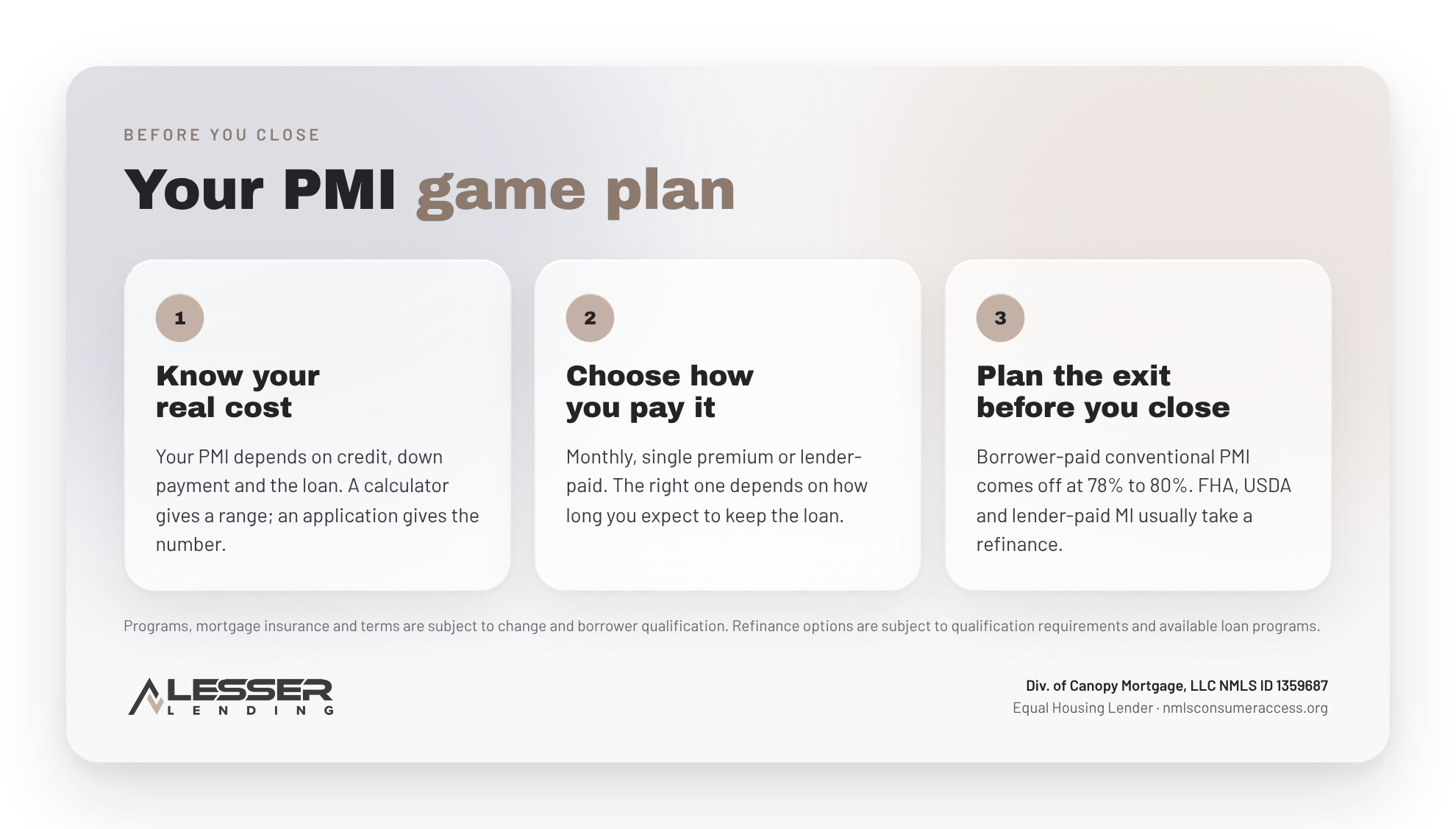
PMI isn't a penalty. It's the price of buying sooner. Understand what drives the cost, choose how you pay it on purpose, and plan your exit from the start, whether that's reaching 78% or a refinance down the road. Subject to qualification requirements and available loan programs.
If you want to see what this looks like with your numbers, apply here. We'll review available loan options based on your qualifications. Prefer to talk first? Book a call or reach us at (509) 749-8587.
Sources. Freddie Mac, "Breaking Down PMI," My Home by Freddie Mac. Consumer Financial Protection Bureau, "When can I remove private mortgage insurance (PMI) from my loan?" Homeowners Protection Act of 1998. U.S. Department of Housing and Urban Development, FHA annual mortgage insurance premium reduction, Mortgagee Letter 2023-05. One Big Beautiful Bill Act (2025), mortgage insurance premium deduction, effective tax year 2026. IRS Publication 936, Home Mortgage Interest Deduction.
Lesser Lending is a Division of Canopy Mortgage, LLC | Equal Housing Lender | NMLS #1359687 (nmlsconsumeraccess.org) | Dave Lesser NMLS #189561 | Licensed in WA and ID | 11917 E Broadway Ave, Suite 201, Spokane Valley, WA 99206 | (509) 749-8587
State Licenses | Privacy Policy | Terms of Use
This content is for educational purposes only and is not a commitment to lend. Programs, rates, mortgage insurance premiums, and terms are subject to change and borrower qualification. All payment and cost figures are hypothetical examples, not a quote or offer of credit; actual rates, APR, mortgage insurance, and payments depend on your credit, loan amount, property, and program, and require a completed application. Payment examples do not include taxes and insurance; actual payments will be higher. Refinance options are subject to qualification requirements and available loan programs. Tax information is general and not tax advice. Consult a tax advisor.



Get the next one
in your inbox.
New articles from the Lesser Lending team, sent as they go live. Just your name and email.
Rather talk it through? Book a call →