What Documents Do Lenders Need? (And Why Screenshots Don't Count)
A screenshot of your bank balance isn't a bank statement. It's a picture of a number.
That one difference is behind more "can you resend that?" emails than anything else in a mortgage file. Buyers aren't trying to cut corners. They're trying to be fast. But a document an underwriter can't use doesn't save time. It costs a round trip.
Here's what lenders actually need, why each piece matters, and the small mistakes that quietly slow a file down.
Why lenders need documents in the first place
Your lender isn't asking for paperwork because they doubt you. An underwriter has to verify everything the loan is built on: who you are, what you earn, what you have, and where your money came from. "The borrower said so" doesn't pass. A document from a third party, like your employer, your bank, or the IRS, does.
That's also why the details on each document matter so much. A pay stub proves income only if it shows who paid you, for what period, and what you've earned so far this year. A bank statement proves assets only if it shows your name, the bank, the account, the dates, and every transaction in that window.
The core documents most buyers need
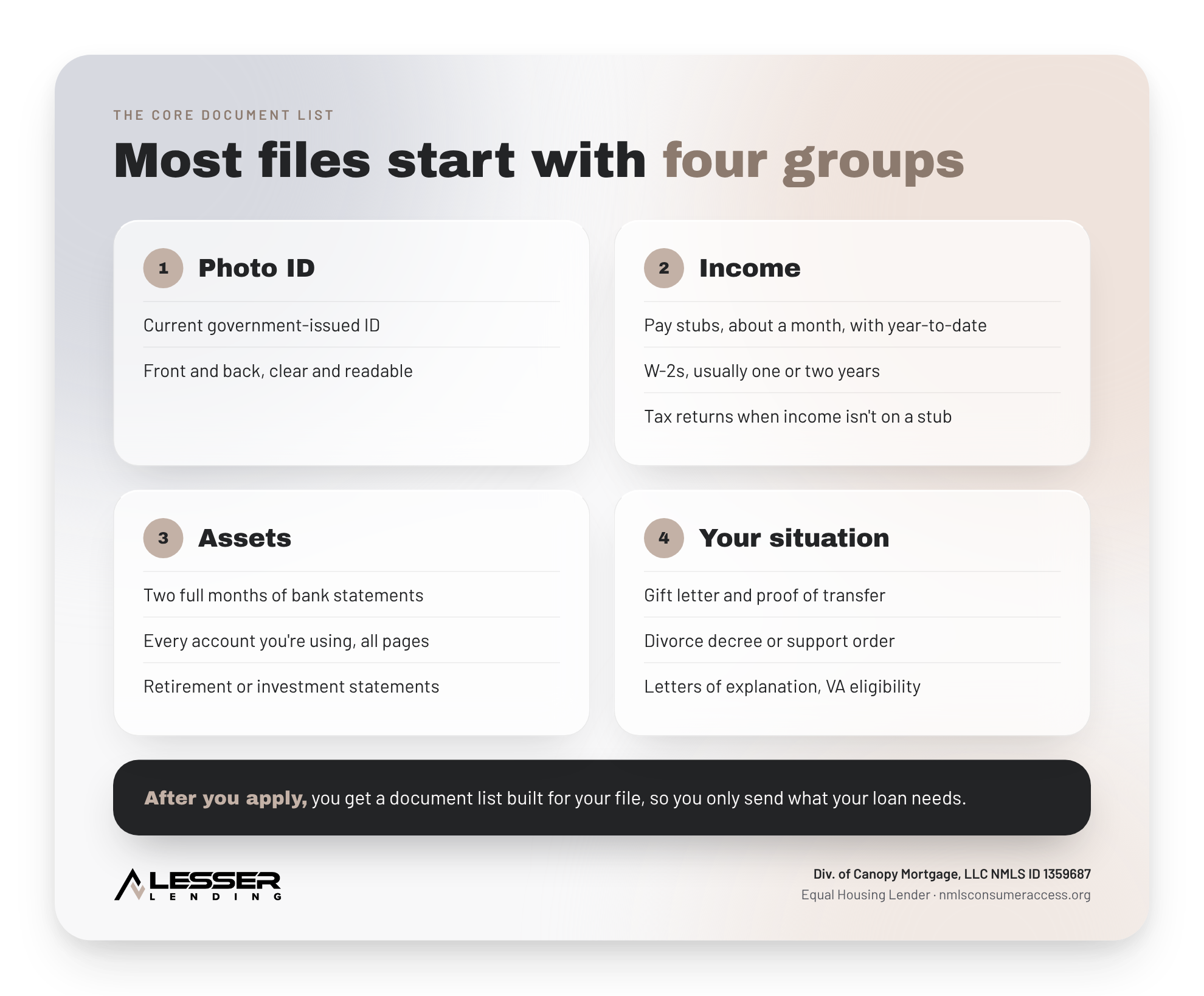
Every file is different, and the exact list depends on the loan program and your situation. But most purchase files start with the same four groups.
Photo ID
A current, unexpired government-issued photo ID, like a driver's license or state ID. Front and back, clear and readable.
Income documents
Pay stubs: your most recent stubs covering about a month, showing year-to-date earnings.
W-2s: usually the last one or two years, depending on the type of income (or 1099s if applicable).
Tax returns: often needed if you're self-employed, earn commission or bonus income, own rental property, or have other income that doesn't show up on a pay stub.
Other income: award letters for Social Security, pension, disability, or similar income, if you're using it to qualify.
Asset documents
Bank statements: for a purchase, typically the most recent two full months for every account you're using for down payment, closing costs, or reserves. All pages.
Retirement and investment statements: the most recent statement, if those funds are part of your picture.
Situation-specific documents
Gift letter if family is helping with the down payment, plus proof of the transfer.
Divorce decree or support order if you pay or receive support.
Letters of explanation for things like gaps in employment, recent credit inquiries, or unusual deposits.
VA eligibility for VA loans. Your lender can usually pull your Certificate of Eligibility directly, and may ask for a DD-214 or statement of service if needed.
Do this instead: Don't build your own list off the internet. After you apply, your lender should give you a document list built for your file, so you're not guessing.
Ready to get started? Apply with us and we'll review available loan options based on your qualifications.
Mistakes that slow a file down
None of these will sink a loan by themselves. All of them add days.
Mistake 1: Sending screenshots instead of statements
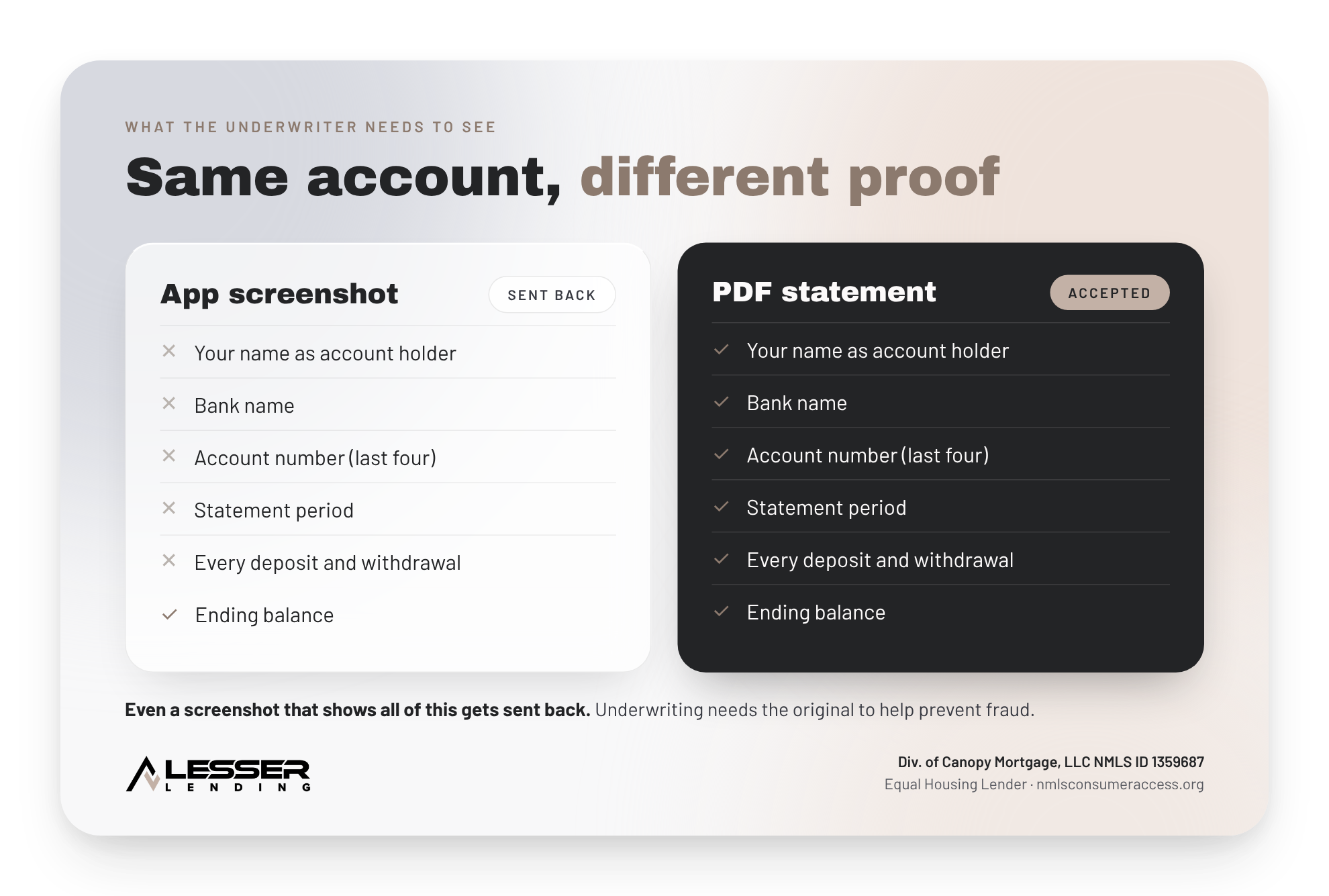
This is the big one. A screenshot from your banking app usually shows a balance and a few recent transactions. What it doesn't show is what the underwriter actually needs: your name as the account holder, the bank's name, the account number (at least the last four digits), the statement period, every deposit and withdrawal, and the ending balance.
Fannie Mae's guidelines spell out those same items for asset statements, and a screenshot almost never has all of them. But here's the part most people don't expect: even if your screenshot shows every one of those details, underwriting still won't accept it. A screenshot is easy to edit and impossible to verify as the original, so requiring the actual document from the bank helps prevent fraud. That's why we don't accept screenshots for income or asset documents at Lesser Lending. It isn't us being difficult. It's us not sending your file to underwriting with something we already know will come back.
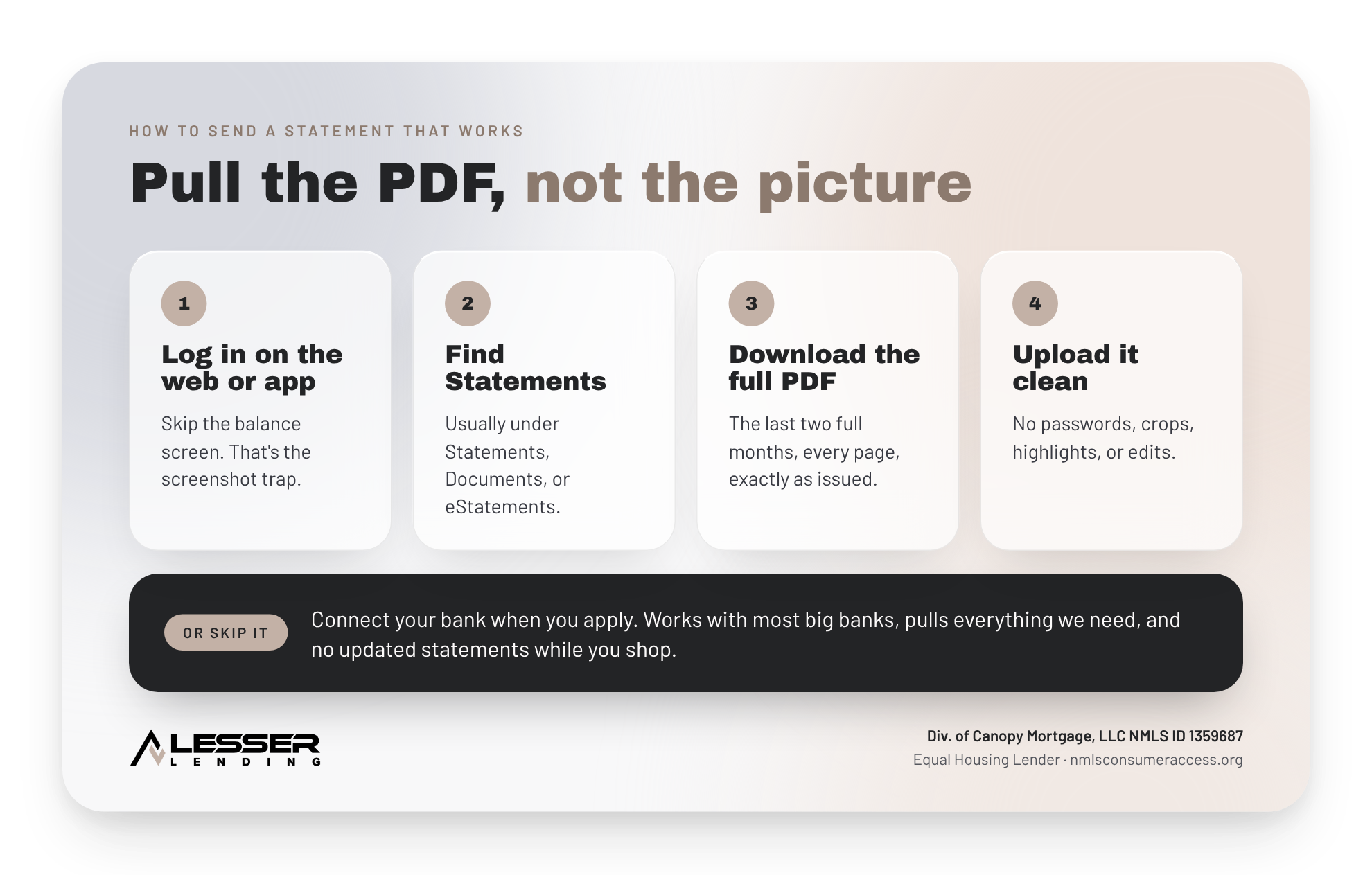
Do this instead: Download the official PDF statement from your bank's website or app. It's usually under "Statements" or "Documents," not the main account screen.
Applying with Lesser Lending? You may not need statements at all. You can securely connect your bank account, and our system pulls everything underwriting needs straight from the source. It works with most big banks, and you won't have to keep sending updated statements while you shop. Apply with us and we'll review available loan options based on your qualifications.
Mistake 2: Leaving out pages
If the statement says page 1 of 6, the underwriter needs all six pages. Every page counts, even the blank ones. A missing page could hold a transaction, so it gets treated like one does.
Do this instead: Send the whole statement exactly as the bank produced it. Don't trim the "boring" pages.
Mistake 3: Sending a transaction history instead of a statement
Transaction histories and "recent activity" printouts feel official, but they often skip the account holder's name, cover an odd date range, or leave off the starting and ending balance. Some lenders can use them in certain cases. Most of the time, they lead to a follow-up request.
Ask your lender this: "If I can't get a statement for this account, what's the best alternative?" A good lender will tell you what works before you go hunting.
Mistake 4: Large deposits without a paper trail
Any deposit that isn't your regular paycheck may get a question. Cash, a transfer from someone else, a side job payment, a sold car. None of that is a problem on its own. Unexplained money is a question, not a problem. It just needs a source.
Do this instead: Keep a record when unusual money comes in: a bill of sale, a gift letter, a copy of the check. And skip depositing cash you've been holding at home without talking to your lender first.
Mistake 5: Moving money around without telling your lender
Shifting funds between your own accounts seems harmless. To an underwriter, money leaving one account and showing up in another means both accounts now need to be documented. Opening a new account mid-process adds the same work.
Ask your lender this: "Is there anything I should leave alone until we close?" Ask before you move it, not after.
Mistake 6: Sending files that can't be opened or have been edited
Password-protected PDFs, photos taken at an angle, cropped images, highlighted or marked-up statements, and files renamed "scan001" all slow things down. Anything that looks altered, even with good intentions like blacking out an account number, can trigger a request for a clean copy.
Do this instead: Send clean, original PDFs with no edits. If you need to protect something, ask how to send it securely instead of redacting it yourself.
The easiest way to send asset documents
In a lot of cases, you can skip downloading statements entirely. When you apply with Lesser Lending, you can securely connect the accounts you'll use for your purchase. That gives us verified account data straight from your bank, which is cleaner for underwriting and less work for you.
If you'd rather upload statements, that works too. Just make sure they're the full, official PDFs.
After you apply, you'll get a personalized document list for your file, so you only send what your loan actually needs. Want to see how the whole process flows from here? Our home loan process page walks through every step.
Do this instead: Connect your accounts when you apply if you can. It's the fastest way to clear the asset part of your file.
Why your lender asks again before closing
Documents have a shelf life. If time passes between your pre-approval and your closing, your lender will likely ask for updated pay stubs and statements. That isn't a sign something is wrong. It's how the underwriter confirms nothing has changed. If you connected your bank accounts when you applied, the updated asset information comes through on its own, so pay stubs are usually the only thing left to send.
Your file isn't done until it closes. Keep your job steady, keep your money where it is, and keep new credit off the table until you have keys.
Ask your lender this: "What will you need from me again before closing, and when?" Knowing it's coming makes it a quick upload, not a surprise.
If you're getting ready to buy, the easiest first step is a full review. Apply with us and we'll look at your income, assets, and credit, and tell you exactly what we'll need. Prefer to talk it through first? Book a call.
FAQ
Will a lender accept screenshots of my bank account?
No. Screenshots rarely show your name, the bank, the account number, the full statement period, and every transaction. And even one that does still won't be accepted, because a screenshot can't be verified as the original document, and requiring the real statement helps prevent fraud. At Lesser Lending, we don't accept screenshots for income or asset documents. The easiest route is connecting your bank when you apply, so there's nothing to send at all. Otherwise, download the official PDF statement.
How many months of bank statements do I need to buy a house?
For most purchase loans, plan on the most recent two full months for each account you're using, all pages included. The exact requirement can vary by loan program, so your lender's document list for your file is the one to follow.
Do I need tax returns if I'm a W-2 employee?
Often not. Many W-2 borrowers qualify with pay stubs and W-2s alone. Tax returns usually come into play with self-employment, commission or bonus income, rental income, or other income that doesn't show on a pay stub.
What counts as a large deposit?
It depends on the loan program and your income, and your lender will flag anything they need explained. The simple version: if money came from anywhere other than your regular paycheck, be ready to show where it came from.
What's the best way to know exactly what I need?
Apply. Generic checklists can't account for your income type, your accounts, or your loan program. Apply with us and we'll review available loan options based on your qualifications, then send you a document list built for your file.
Sources. Fannie Mae Selling Guide, B3-4.2-01, Verification of Deposits and Assets. Fannie Mae Selling Guide, B3-3.1-02, Standards for Employment Documentation. Consumer Financial Protection Bureau, homebuying and mortgage process resources.
Lesser Lending is a Division of Canopy Mortgage, LLC | Equal Housing Lender | NMLS #1359687 (nmlsconsumeraccess.org) | Dave Lesser NMLS #189561 | Licensed in WA and ID | 11917 E Broadway Ave, STE 201, Spokane Valley, WA 99206 | (509) 749-8587
This content is for educational purposes only and is not a commitment to lend. Document requirements vary by loan program, lender, and borrower situation. Programs, rates, and terms are subject to change and borrower qualification.



Get the next one
in your inbox.
New articles from the Lesser Lending team, sent as they go live. Just your name and email.
Rather talk it through? Book a call →